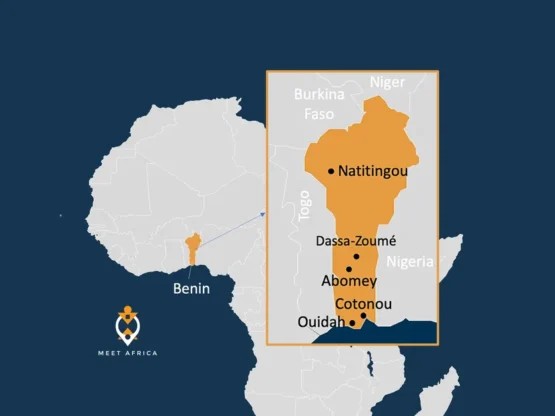
Tucked between the Gulf of Guinea and the broader savannah belt of West Africa, Benin is more often associated with cotton, voodoo, and its coastal city vibes than with mining. Yet beneath its soil lies a modest but variegated portfolio of mineral resources — from cement-grade limestone to episodic gold, gemstones, and tantalum prospects. Though mining remains peripheral to Benin’s economy, recent exploration activity signals potential for a deeper resource push — provided the right mix of investment, regulation, and environmental care.
The Dominant Role of Industrial Minerals: Cement, Limestone, Marble, Sand & Gravel
For decades the bulk of mining in Benin has been in industrial minerals rather than metals. The main output comes from materials such as cement, limestone, marble, sand, gravel, clay, and building-stone aggregates. (D9 Wret S3)
Cement production remains the clearest signal of activity. A 2015 report noted that cement was the only mineral commodity in Benin for which consistent production data existed — about 1.8 million metric tons that year — thanks in large part to the full operation of the country’s newer plant, Nouvelle Cimenterie du Bénin (NOCIBE), which effectively doubled national cement-production capacity. (D9 Wret S3)
These industrial-minerals outputs feed directly into construction and infrastructure demand — vital given urbanisation and domestic development needs. (Wikipedia)
Gold, Gems and Tantalum: Small-Scale, Artisanal and Under-explored
Beyond industrial minerals, Benin does have deposits of precious and semi-precious materials — albeit exploited mostly on a small or artisanal scale.
- Gold: Known mainly from the northwestern Atakora Mountains (near villages such as Kwatena and Tchantangou) and alluvial deposits along the Perma River and tributaries. Most gold extraction is artisanal. (Wikipedia)
- Colored gemstones & pegmatite-related minerals: Reports and exploration permits have identified potentials for gemstones like tourmaline and aquamarine (blue beryl), especially in pegmatite belts. (Investegate)
- Tantalum (and related pegmatite minerals): In 2015, Premier African Minerals — through its local subsidiary G&B African Resources Benin SARL — was awarded exploration rights over a 249.75 km² area in the Collines Department, in central Benin. The permit covers zones that historically saw artisanal activity for cassiterite, tantalum ore, and coloured gemstones. Initial field work reportedly revealed at least three sizable pegmatite structures. (Agence Ecofin)
While none of these non-industrial commodities currently make up large-scale commercial output, their presence underscores Benin’s geological richness and the potential for more intensive mining — if conditions allow. (African Mining)
Hidden or Potential: Iron Ore, Chromium/Chromite and Other Base Minerals
Benin’s subsoil holds more than just cement rocks and gemstones. Geological surveys over decades have identified potential reserves of iron ore, chromium (chromite), rutile/ilmenite (heavy minerals), and silica sands, although these remain largely under-exploited. (Wikipedia)
For instance, low-grade iron-ore deposits have been documented at the Loumbou‑Loumbou deposit and the Madekali deposit in northern Benin’s Borgou region — reserves estimated at hundreds of millions of tons. (D9 Wret S3)
Geological studies also suggest occurrences of chromite (a chromium-bearing ore) hosted in serpentinite rocks within the Pan-African Dahomeyides belt — indicating a potentially valuable chromium resource. (SCIRP)
However, despite the availability, logistical challenges, limited infrastructure, and insufficient large-scale investment have so far prevented these deposits from being turned into full-fledged industrial mines. (Nations Encyclopedia)
Why Mining Remains Marginal: Challenges That Limit Commercial Scale
Even at its peak, mining has never been central to Benin’s economy. According to multiple sources, mining “does not play a significant role” in national GDP. (Wikipedia)
Key limiting factors include:
- Lack of infrastructure (transport, processing, energy) to support large-scale mining or value addition.
- Fragmented artisanal mining that often remains informal, limiting volume, regulatory oversight, and tax revenue.
- Underdeveloped geological exploration and limited investment, especially for non-precious-metal deposits (iron, chromium, heavy minerals).
- Environmental and social risks tied to mining in ecologically sensitive or forested zones — concerns that amplify when mining is proposed near protected areas. (minesactu.info)
A Turning Point? Renewed Exploration and Promise
In recent years, there has been renewed interest from international and regional mining companies. The 2015 exploration licence awarded to Premier African Minerals is one such sign — highlighting pegmatite belts with tantalum and gemstone potential in central Benin. (Agence Ecofin)
Meanwhile, Benin’s government has publicly affirmed that mineral deposits (including iron ore and phosphate) exist, and that resource development remains part of longer-term planning — though with no major breakthroughs to date. (Nations Encyclopedia)
Experts and analysts note that if iron-ore and heavy-mineral deposits are properly developed, and if conditions for infrastructure, regulation and environmental oversight improve, Benin could slowly broaden the contribution of mining to its economy. (Nations Encyclopedia)
What It Means for Benin: Opportunities and Trade-offs
- Opportunities: growth in mining could stimulate jobs (especially in rural areas), attract foreign investment, reduce import-dependence for cement and construction materials, and develop a nascent industrial-minerals and metals export sector.
- Risks: poorly managed mining can damage ecosystems, threaten protected areas and biodiversity (notably in forested northern and central zones), and reinforce informal, artisanal mining with little benefit to the state or local communities. (minesactu.info)
- Policy and governance challenge: to realize Benin’s mineral potential, strong regulation, transparent permitting, environmental safeguards, and investment in infrastructure (roads, energy, processing) will be critical.
Conclusion
Benin may not rank among Africa’s mining heavyweights — yet its subsoil tells a story of quiet potential. From cement-grade limestone and building aggregates to hidden iron ore, tantalum-bearing pegmatites and gold-bearing veins, there is a foundation for a more diversified mining sector. But unlocking it will require vision, investment, and discipline. The rock is there — whether Benin’s leaders and partners build on it remains the real question.
References
- U.S. Geological Survey, The Mineral Industry of Benin (2003 / 2014–2015 reports). (D9 Wret S3)
- Country profile, Mineral industry of Benin — Wikipedia (summary of outputs, commodities, and context). (Wikipedia)
- Benin remains underexplored — mining-analysis article on gold, iron, heavy-minerals and potential in Benin. (African Mining)
- News report: Premier African Minerals wins exploration permit in the Collines department — 2015 exploration for tantalum and gemstones. (Agence Ecofin)
- Geological study: Chromiferous mineralization in the Pan-African Dahomeyides belt (Northwestern Benin) — evidence for potential chromite (chromium ore) deposits. (SCIRP)